Cinderella
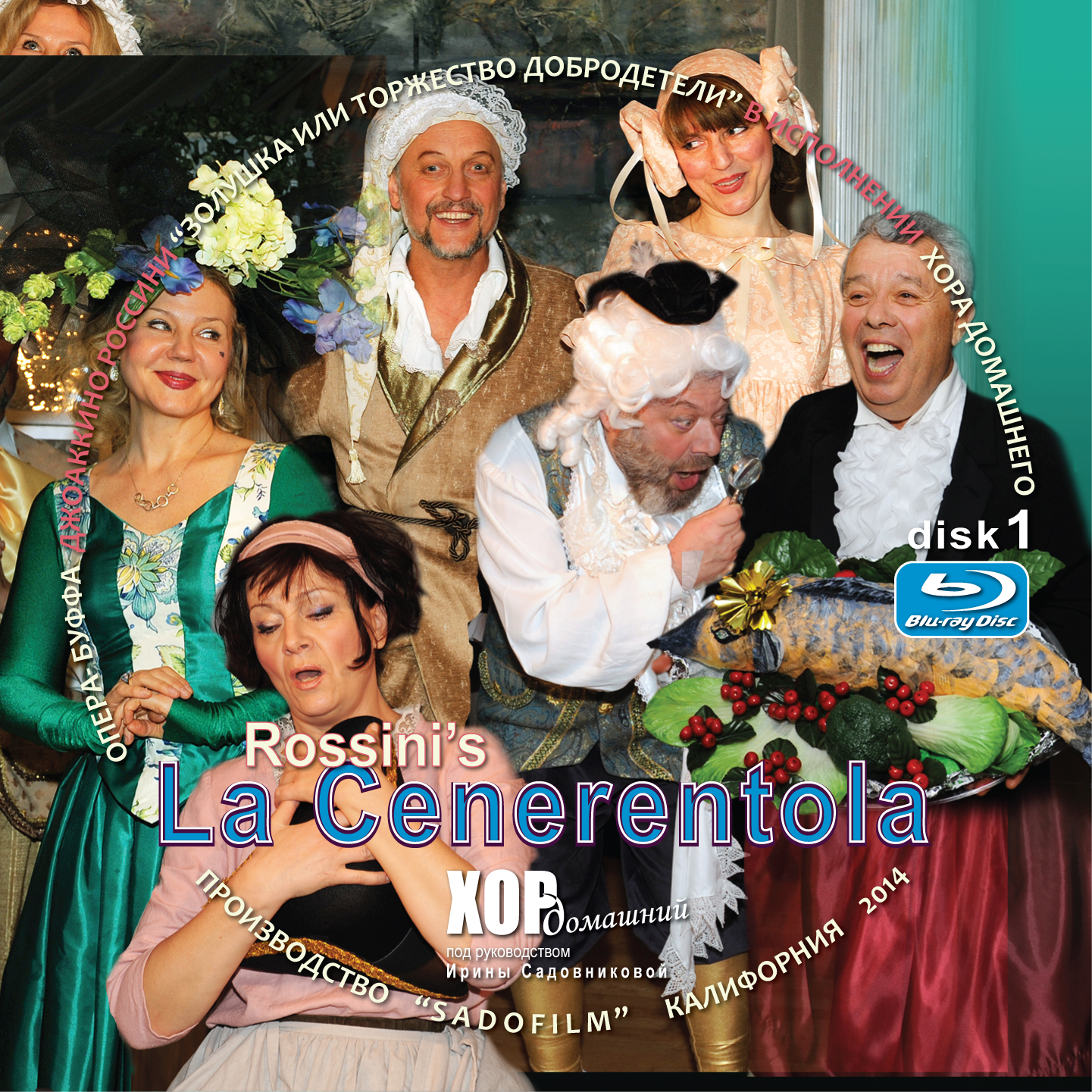
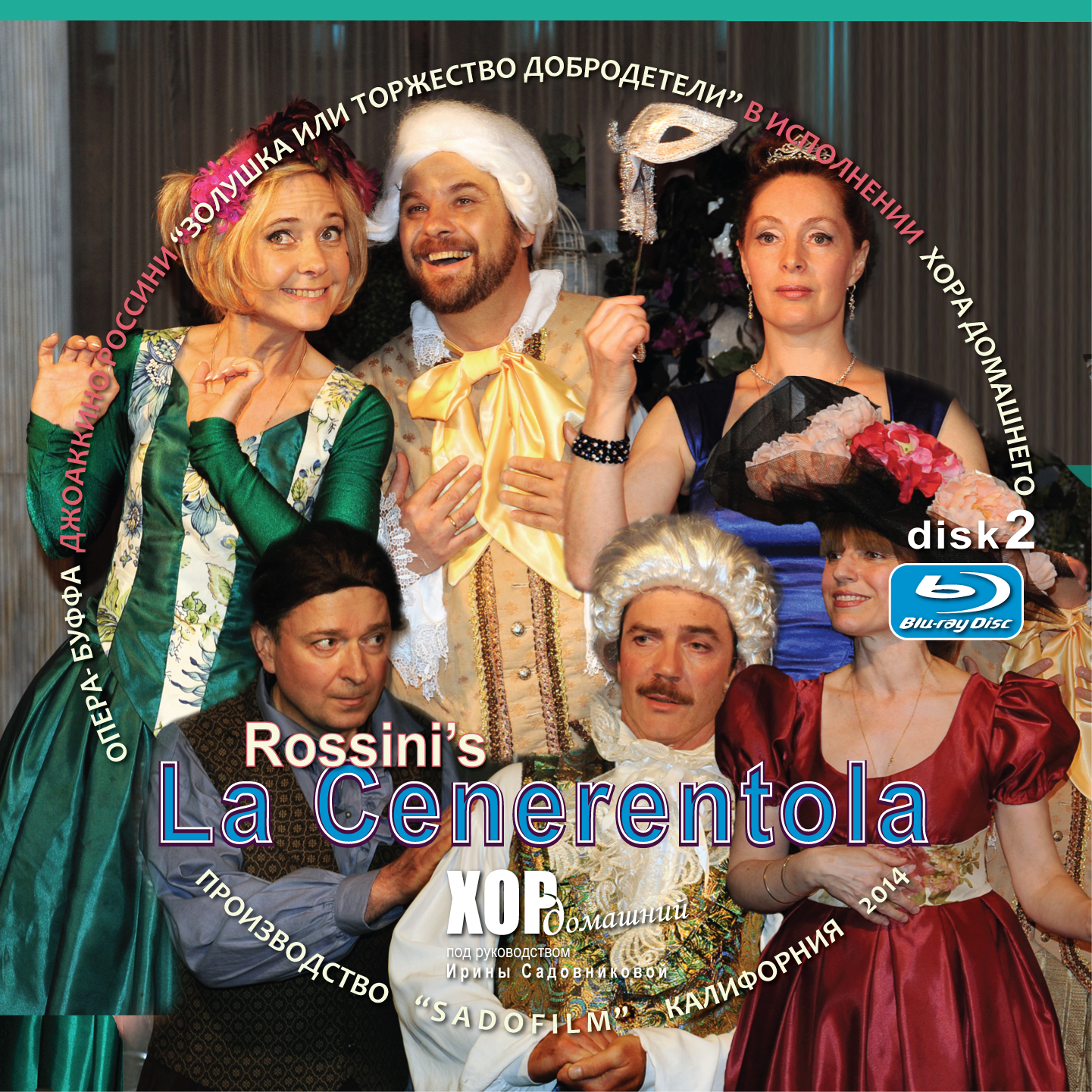
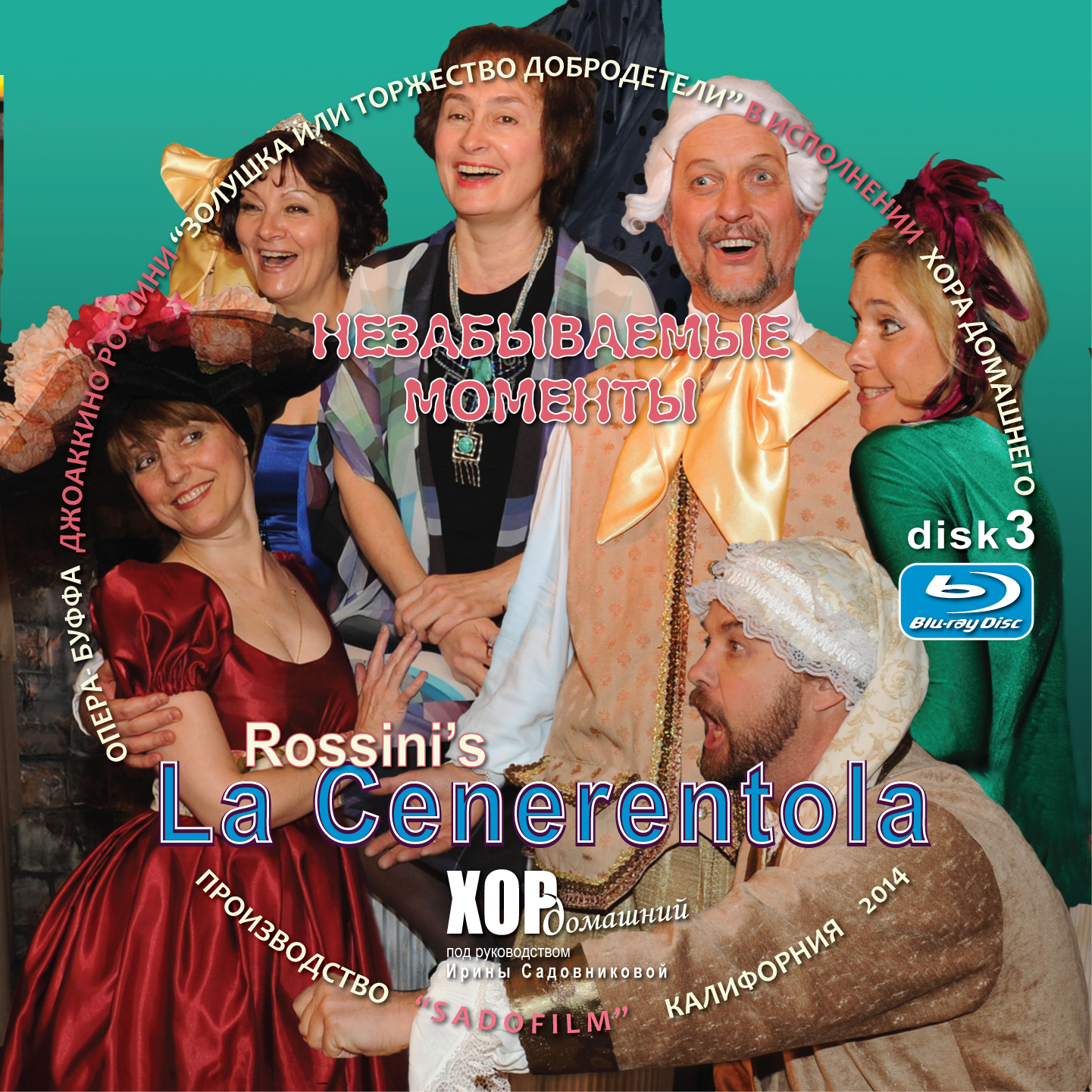
Gioachino Rossini's opera buffa "La Cenerentola" ("Cinderella, or Goodness Triumphant"), with a libretto by Jacopo Ferretti, written in just 24 days in 1816. It premiered on 25 January 1817 at the Teatro Valle in Rome.

The opera "La Cenerentola, or Goodness Triumphant" was written by Gioachino Rossini and the librettist Jacopo Ferretti in 1816, in just 24 days. It premiered on 25 January 1817 in Rome, at the Teatro Valle. As usual, Rossini reused earlier music: the overture came from his own opera «La gazzetta», and some pieces from «The Barber of Seville». The plot only distantly resembles the traditional fairy tale: instead of a wicked stepmother the authors introduced a stepfather, Don Magnifico; instead of a fairy godmother, Alidoro, the wise tutor of Prince Ramiro.
We first got to know the opera many years ago at the local opera house in San Jose. We watched it, were enchanted, and that was when the dream was born — to stage this opera at home. At first it seemed completely unrealistic. But the years went by, the repertoire of Khor Domashniy kept getting more ambitious, and once we had mastered "Nord-Ost" and "Les Misérables" we thought: why not take on Gioachino — our very own Rossini?
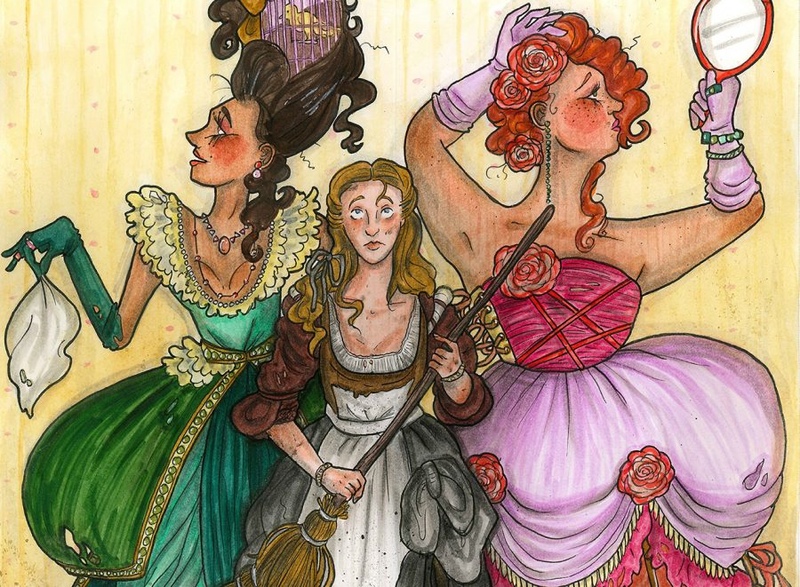
The first task was to get hold of a vocal score with a Russian text. With the internet as developed as it is today, this seemed perfectly doable, and Alexei set about it with enthusiasm, not yet suspecting what lay ahead. He quickly found and bought a CD of "Cinderella" recorded at the Bolshoi Theatre in 1950 with Zara Dolukhanova in the title role. If it was performed in Russian, then a ready-made score with Russian text must exist somewhere! Not so fast...
The opera was first translated into Russian and staged in 1896. A vocal score was published. The translator's name even flashed by once, but we could never find it again. In the USSR Rossini was for some reason out of favour and his operas were hardly ever staged. Even in today's Russia they have only begun to be performed often in the last few years. In short, a "Russian" score exists nowhere. We had to borrow an "Italian" vocal score with an English interlinear translation from the local university library. The text was not easy either. First, when two people sing in an opera, it is already hard to make out the words by ear; with more than two it is impossible — after all, they usually sing different words! Well, you can guess a thing or two with the help of the English crib; and in the choruses it hardly matters what you sing anyway. But here was the problem: either Rossini created a great many versions of the opera, or someone at the Bolshoi did a good job with scissors, but of Don Magnifico's four arias the Russian CD had only two! And in place of Alidoro's only aria came Cinderella's eighth or ninth! Alexei, as the future Don Magnifico and a fighter for operatic equality, could not stand such arbitrariness, so he wrote texts for Don Magnifico's missing arias and rewrote one of Cinderella's arias for Alidoro.
Next. Of course, the words in an opera are not the most important thing, and the translation as a whole was good. But sometimes something quite absurd came out. In the wonderful choral scene in the middle of the second act, all the characters gather around a richly laid table and sing roughly the following:
"I'm asleep and dreaming of a green garden.
Little birds are singing, and I am so glad.
But gradually I wake up
And I am horrified by reality."
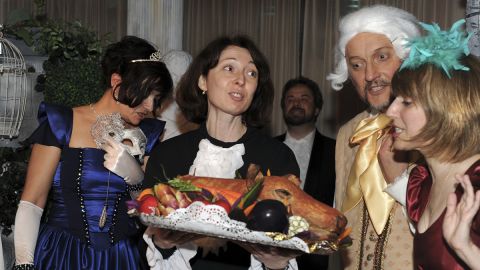
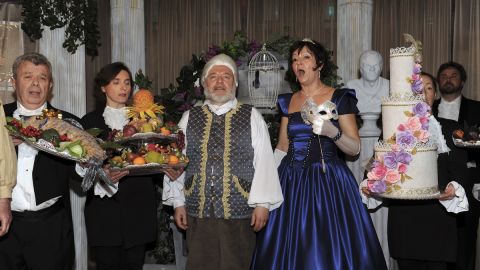
The meaning is clear enough: we've had a lovely dream, but things are heading for the denouement. But what does that have to do with a laid table? And here is what we sang when the marvellous platters of food, made by Irina Khodyakina, were carried onto the stage:
"Here comes the longed-for supper, the long-awaited tasty supper,
Five sturgeons, twenty dozen fresh oysters.
Here are lovely appetisers, fricassee of wagtail,
And roast Indian-style, chicken rumps.
Our dresses will be tight, and our blouses will be tight on us.
The aroma of eastern spices, the dishes caress the eye.
Heavenly delight awaits us soon.
But it is written on the tablets:
In rich food there are many sorrows.
......."
And then strictly according to the plot. Of course, it's no Pushkin, but how much more pleasant it is to sing!
The rest was, as they say, a matter of technique: hours of rehearsals, volunteer workdays building the sets, sewing the last buttons onto costumes a minute before the premiere. The result — as usual: success, standing ovations, bonnets flying through the air...
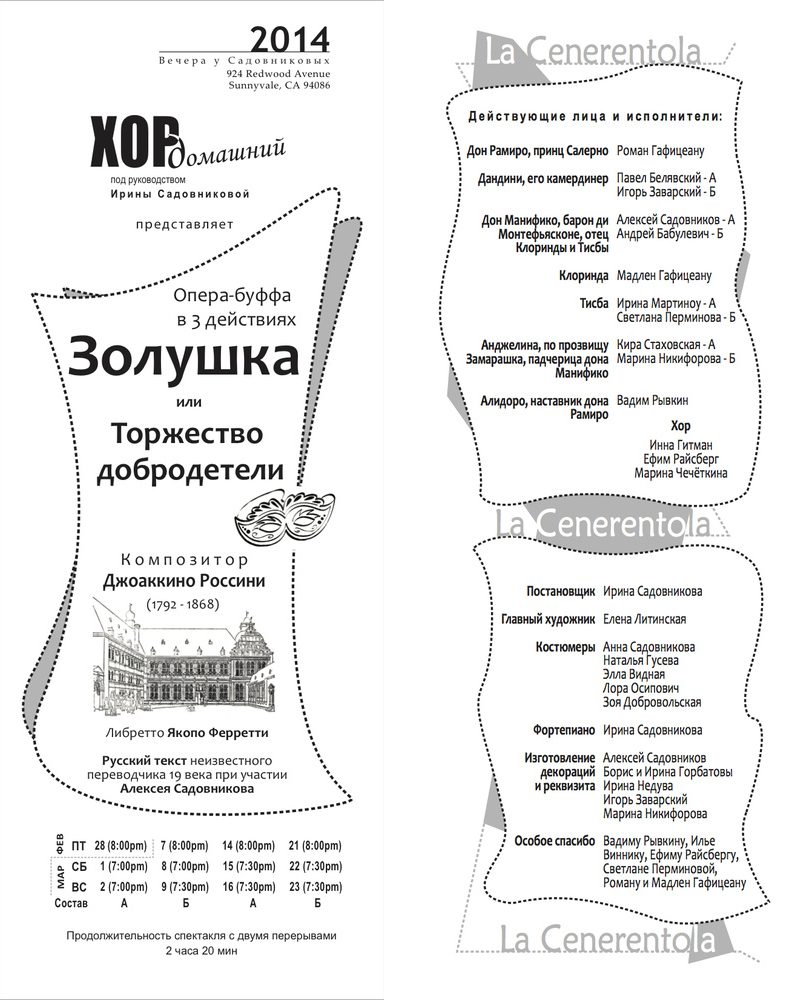
Cast
| Role | Cast A | Cast B |
|---|---|---|
| Дон Рамиро | Roman Gafiteanu | |
| Дандини | Paul Belasky | Igor Zavarskii |
| Дон Манифико | Aleksei Sadovnikov | Andrei Baboulevitch |
| Клоринда | Madlen Gafiteanu | |
| Тисба | Irina Martineau | Sveta Perminova |
| Анджелина | Kira Stakhovskaya | Marina Nikiforova |
| Алидоро | Vadim Ryvkin | |
| Chorus | Inna Gitman, Marina Chechetkina, Fima Raizberg | |
Playbill
Gallery
Video